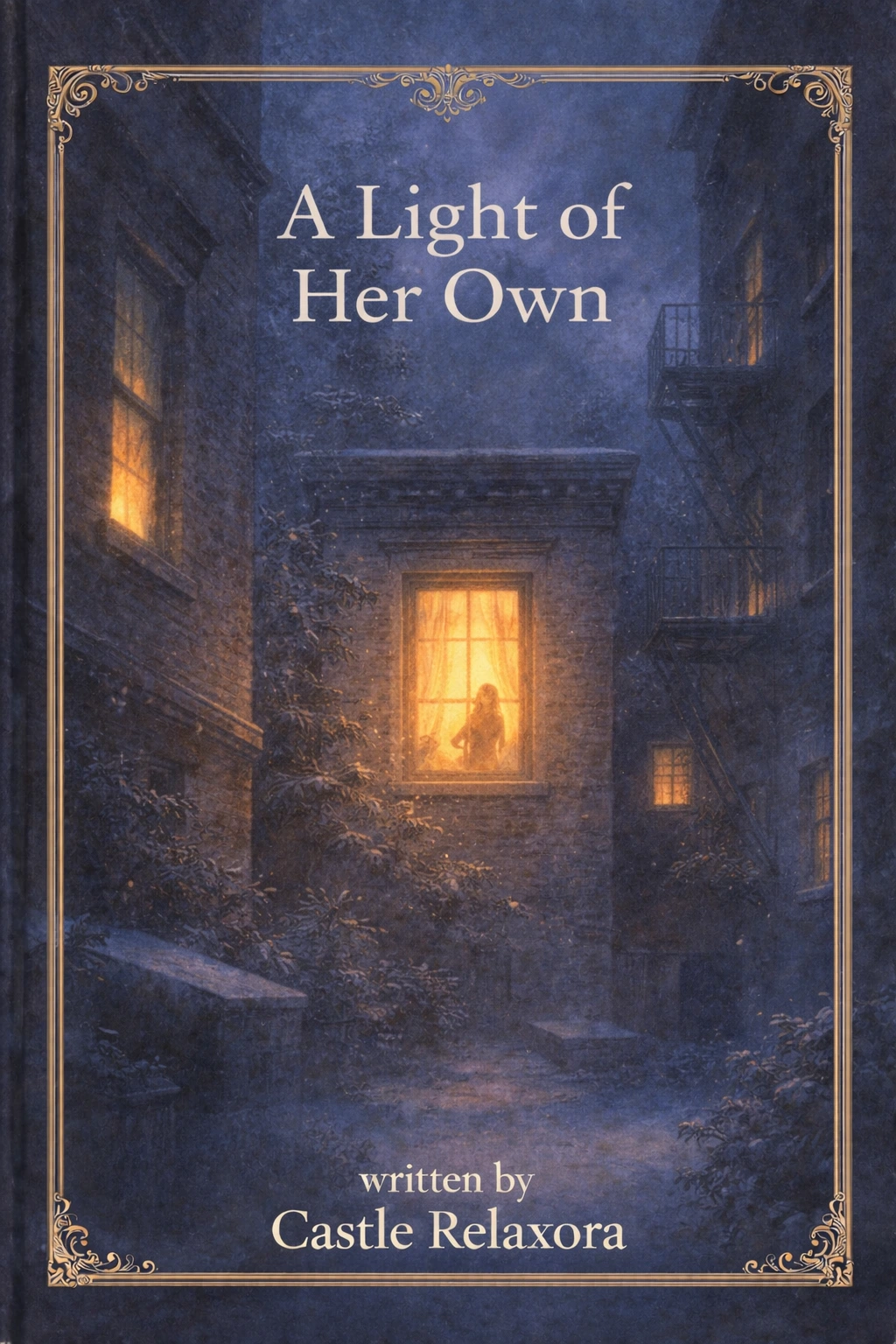
Chapter 1 — Winter Windows

The wind always found its way through Sycamore Lane. It slipped between buildings, curled around corners, and pressed gently, but persistently, against anyone who walked its narrow stretch. That January, it carried the kind of cold that didn’t just touch the surface of your skin, it settled deeper, lingering even after you stepped indoors.
Elina pulled her coat closer as she approached the brownstone. Her boots moved steadily over the thin layer of snow, each step measured, practiced. She had long ago learned how-to walk-through winter without fighting it, how to move with it, not against it. Shoulders steady. Breath even. Eyes forward.
Inside, the building greeted her with warmth that felt earned. Not immediate. Not overwhelming. Just enough.
She brushed the snow from her coat in the entryway, the quiet thud of it falling to the tiled floor echoing softly. The hallway smelled faintly of old wood and something citrus-clean, a scent that never quite left no matter the season. Third floor. Always the same climb. Always the same rhythm.
Apartment 3C welcomed her in its own quiet way. The floorboards creaked, not loudly, but with a kind of familiarity, as though acknowledging her return. The air held the scent of books and time, something soft and settled into the walls from years before she ever arrived. She placed her keys in the small ceramic dish by the door. Removed her coat. Paused.
Elina liked this moment. The one between outside and inside. Between movement and stillness. It was small, but it belonged entirely to her.
At thirty-four, Elina’s life had taken shape slowly. Not dramatically. Not according to anyone else’s expectations. Brick by brick. She had a career she respected, senior project manager at a design firm where her voice carried weight, where her work was seen. Her days were structured but not suffocating, demanding but not consuming. She lived alone. And she liked it.
That didn’t stop the questions. Coworkers who tilted their heads slightly too long. Family members who softened their voices when they asked, “But don’t you want more?” More what? More noise? More expectation? More explanations?
Elina had learned not to answer those questions fully. Not because she didn’t have answers. But because they weren’t really asking.
Her evenings were her own. She cooked simple meals, warm, steady, enough. Sometimes she painted, the corner near her window filled with canvases in various states of becoming. Other nights, she read books worn from second-hand shops, their pages holding stories that had already lived other lives. And every night at 9 p.m. she made tea. Not a routine. A ritual.
That January, something changed. It began quietly. Almost invisibly. Across the alley, in the building opposite hers, there was a window. Third floor. Right side. She had noticed it before, of course. You couldn’t not notice something that sat directly in your line of sight. But it had always been just another window, dark, ordinary, part of the background.
Until one evening, it wasn’t. A light appeared. Not bright. Not artificial. Soft. Golden. Elina noticed it without trying to.
She stood by her window, mug in hand, the steam rising gently between her and the glass. And there it was, across the narrow stretch of alley, glowing in a way that felt… intentional. Not like a lamp. Not like overhead lighting. Something else. She watched for a moment. Then looked away. Then back again. It stayed.
The next night, it returned. Not at the same time. Not with the same intensity. But it was there.
Days passed. The light became part of her awareness. Not something she waited for. But something she noticed. Sometimes it appeared just after seven. Sometimes later. Sometimes, not at all. And when it did appear, it changed the feeling of the evening. Shadows moved behind the curtain. Slowly. Not hurried. A figure, perhaps a woman, crossed the space occasionally, never fully visible, always partially obscured.
Once, A hand pressed briefly against the glass. Then disappeared. Another night, Music. Faint. Piano. Not perfect. Not rehearsed. But real. Elina stood very still that night. Her tea cooled unnoticed in her hands. The alley, usually quiet and unnoticed, became something else entirely. A space between two lives. Two windows. Two presences.
She didn’t feel like she was watching someone. She felt like she was witnessing something. Something soft. Something human. Something quietly beautiful. And without realizing it, she began to carry it with her. Into her mornings. Into her work. Into the spaces between her thoughts.
Not the person. Not the story. Just, the light.
Chapter 2 — The Light That Waited

The light did not follow a pattern. That was the first thing Elina noticed.
If it had appeared at the same time each evening, she might have dismissed it as routine, something ordinary disguised by distance. But it didn’t. Some nights it glowed early, catching the last trace of dusk. Other nights it appeared much later, long after the alley had settled into silence.
And sometimes, it didn’t appear at all. At first, Elina told herself it didn’t matter. It was just a window. Just light. Just someone else’s life moving independently of her own.
But she began to notice the absence. Not sharply. Not in a way that disrupted her day. But in small, quiet ways.
She would return home, remove her coat, move through her evening as she always did. Dinner. A book. The familiar rhythm of her space. And then, almost without thinking, she would glance toward the window. Not expecting. Just checking.
When the light was there, Something softened. The room felt warmer, even before she touched her tea. The silence carried a different quality, not empty, but shared, as though something just beyond her reach was unfolding in parallel.
When it wasn’t, the space felt unchanged. And yet, not quite the same.
One evening, as January deepened into its quiet middle, the light appeared earlier than usual. Elina had just set her mug down by the window when she noticed it, already glowing, steady and calm, as if it had been waiting. She stepped closer. The glass held a faint chill against her fingertips.
The curtain across the alley was drawn partially open. Enough to reveal movement. A shadow crossed the room. Slow. Measured. Not hurried. Not distracted. The kind of movement that came from intention, not obligation.
Elina watched without leaning in. Without pressing closer. She had no desire to intrude. Only to observe. The figure paused near the window. For a moment, Stillness. Then, a hand lifted. Rested lightly against the glass.
Elina’s breath caught. Not from surprise. From recognition. The gesture was simple. Unremarkable. And yet, it felt familiar. Like something she had done herself, on nights when the world felt quieter than usual. When the boundary between inside and outside seemed thinner, more permeable.
The hand lowered. The figure moved away. The light remained.
That night, Elina didn’t return to her book right away. She sat by the window longer than usual, her tea cooling slowly, the warmth fading unnoticed. The piano came a few nights later.
At first, she thought it was memory. A sound carried from somewhere distant, mistaken for something nearer. But as she stood still and listened, it became clearer. Notes. Not perfect. Not polished. But intentional.
They drifted across the alley in uneven fragments, sometimes pausing, sometimes repeating, sometimes resolving into something almost familiar before shifting again. It wasn’t a performance. It wasn’t meant to be heard. And yet, it reached her.
Elina leaned her shoulder lightly against the wall beside the window, closing her eyes for a moment as the sound settled into the space around her. She didn’t try to identify the piece. She didn’t need to. It was enough to listen.
The music stopped as gently as it had begun. No final note. No clear ending. Just silence. But not the same silence as before.
After that, the light became something else entirely. Not just a presence. A question. Who was there? What kind of life moved behind that window? What kind of quiet did they live in? Elina didn’t feel the need to know in a direct way. She didn’t imagine conversations. Didn’t create stories to fill the gaps.
Instead, she allowed the not knowing to exist. And in that space, something unexpected happened. She began to notice her own evenings differently. The way her apartment held sound. The soft hum of the refrigerator. The faint creak of the floor when she shifted her weight. The rhythm of her own movements, cutting vegetables, turning pages, pouring tea.
She had always known these things were there. But now, she paid attention.
One night, she paused in the middle of her routine. Knife in hand. Vegetables half-prepared. She stood still. Listened. Not for the piano. Not for the light. But for her own space. And for the first time in a long while, it didn’t feel like something to fill. It felt like something to be in.
She finished her meal slowly that evening. Sat longer at the table. Didn’t turn on music. Didn’t reach for her phone. At 9 p.m., she made her tea as always. But this time, she carried it to the window with more intention.
The light was there. Steady. Warm. Unchanging. Elina didn’t watch for movement. Didn’t wait for the figure. She simply stood. Mug in hand. Breath steady. And for a moment, there was no distance between the two windows. Not physically. But in feeling.
Two lives. Separate. Unconnected. And yet Existing in the same quiet. She lifted her mug slightly. Not a gesture meant to be seen. Not a signal. Just, an acknowledgment. Then she stepped back. The light continued to glow. And that was enough.
Chapter 3 — The Night the Light Disappeared

The light did not return. Not that night. Not the next. Not the one after that. At first, Elina didn’t think much of it.
Absence, after all, had always been part of its rhythm. There had been nights before when the window across the alley remained dark, when the golden glow didn’t appear and the evening passed as it always had, quiet, contained, complete in its own way. So, she didn’t question it. Not immediately.
She continued her evenings as she always did. She came home. Removed her coat. Let the warmth of her apartment settle into her skin. She cooked something simple, soup, usually, or something she could leave simmering while she moved between the kitchen and the living space. She read. She painted.
At 9 p.m., she made her tea. And each night, without intention, she looked. The window remained dark.
The first few days, it barely registered. A small detail. A variation. Nothing more. But as the days stretched into a week, something shifted. It wasn’t the absence itself. It was the space it left behind.
The alley looked the same. The buildings stood unchanged. The window remained exactly where it had always been. And yet, the evenings felt… different. Elina stood by her window one night, mug in hand, her reflection faintly visible in the glass. She tilted her head slightly, as if looking at the space from another angle might change something.
It didn’t. The darkness across the alley was complete. Not heavy. Not ominous. Just empty. She stepped back. Not disappointed. Not upset. But aware.
Aware that something small had quietly become part of her life. And that its absence had left something just as quiet behind. Days passed. Then weeks. The light did not return. Elina didn’t speak about it.
There was no one to mention it to, really. And even if there had been, she wasn’t sure how she would explain it. I miss a light in a window I’ve never entered. I miss a presence I’ve never met. It sounded strange when placed into words. So, she didn’t. Instead, she carried it quietly.
One evening, she found herself standing by the window earlier than usual. The sky was still holding onto the last traces of daylight, pale and stretched thin between buildings. The alley below was quiet, untouched by the usual movement of people. She didn’t have her tea yet. She hadn’t reached that part of her evening. And still, she stood there.
She realized then that it wasn’t curiosity anymore. It wasn’t even expectation. It was habit. And behind it, something else. She moved away from the window. Deliberately. As if creating distance might help her understand what she was feeling. In the kitchen, she paused. Her hands rested on the counter, the familiar surface grounding her.
She closed her eyes briefly. What was it? Not the person. Not the music. Not even the light itself. It was what it had created. A sense of shared quiet. Something that had existed without needing to be defined. Without needing to be explained. She opened her eyes. Exhaled slowly.
That night, she made her tea a little later than usual. Not intentionally. Just… differently. When she brought it to the window, she didn’t look right away. She set the mug down. Stood beside it. Waited. Then, she turned. The window remained dark.
But this time, she didn’t search it. Didn’t scan for movement. Didn’t wait for something to appear. She simply looked. Acknowledged. And then, she smiled. Not because the light was gone. But because it had been there at all. The memory of it remained. Not as something unfinished. But as something complete. A presence that had existed. A moment that had been shared. Even without words. Even without connection.
She lifted her mug. Took a slow sip. The tea was warm. Steady. Familiar. The room held her. The quiet returned. And for the first time since the light disappeared, she didn’t feel its absence. She felt its echo.
The next morning was colder. The kind of cold that sharpened everything, the air, the sound of footsteps, the edges of buildings against the sky. Elina wrapped her scarf tighter as she stepped onto the street. Her breath formed small clouds that disappeared as quickly as they came.
She walked her usual route. Toward the café. Past the same corners. The same storefronts. And then, she slowed. The building across the alley stood just ahead. She hadn’t meant to come here. Not consciously. But her steps had brought her anyway.
She paused at the entrance. Looked up. Third floor. Right side. The window was still. Closed. Unlit. For a moment, she considered walking on. But something held her there. Not urgency. Not need. Just curiosity. The kind that doesn’t demand answers. But quietly asks.
Elina stepped forward. And entered the building.
Chapter 4 — The Woman in the Window

The building felt warmer than the street. Not by much, but enough. The kind of warmth that lingered in old places, where heat settled into the walls over time and never fully left. The lobby was modest, like Elina’s own building, polished wood floors, a narrow staircase, a small desk near the entrance where a man sat flipping through a newspaper.
He looked up as she stepped inside. Not surprised. Just attentive. “Can I help you?” he asked. His voice was gentle, practiced, not overly formal, not overly familiar.
Elina hesitated. Not because she didn’t know what she wanted to ask. But because saying it aloud would make it real. “This might sound a little strange,” she said, her hands still wrapped loosely around the straps of her bag. “I live across the alley. Third floor. I’ve been… noticing a light from one of the windows here.”
The man’s expression shifted slightly. Not confusion. Recognition. “Third floor, right side?” he asked. Elina nodded.
He folded the newspaper slowly, placing it aside. “Ah,” he said softly. “You must mean Mrs. Vale.” The name landed gently. But it carried weight. “Mrs. Vale?” Elina repeated. “Yes,” he said. “Clara Vale.”
There was a pause. A quiet one. The kind that gives space before something changes. “She lived here for over forty years,” he continued. “Passed away last month.” The words didn’t echo. They didn’t drop heavily. They simply… settled.
Elina felt something shift inside her. Not shock. Not grief. Something quieter. Like a realization arriving at its own pace. “Oh,” she said. It was the only word that felt right.
“She was a pianist,” the man added. “Taught students for decades. People came and went, but she stayed. Always stayed.” Elina pictured the window. The soft light. The slow movement behind the curtain. The music.
“She used oil lamps,” he continued, a faint smile touching his expression. “Refused to switch to electric lighting. Said it made everything feel too sharp.” Elina smiled slightly. “That sounds like her,” she said, then paused, realizing what she had just implied. She had never met the woman. And yet, It felt true.
The man nodded. “She liked things to feel… lived in,” he said. “Not rushed. Not overly polished.” Elina glanced toward the staircase. “Is anyone living there now?” He shook his head. “Not yet. The apartment’s still being cleared. Her things are… taking time.”
That made sense. Some lives couldn’t be packed quickly. There was another pause. Not uncomfortable. Just reflective. “We’re holding a small memorial next week,” the man said. “Nothing formal. Just neighbors, a few former students. People who knew her.” He looked at Elina kindly. “You’re welcome to come.”
Elina hesitated again. Not out of uncertainty. But out of surprise. “I didn’t know her,” she said. The man smiled. “Sometimes that’s not the point.” She nodded slowly. And for reasons she didn’t fully understand, she said yes.
The memorial was quiet. Exactly as she expected. It took place in a small community room on the ground floor. The chairs were arranged in a loose circle, not rows. No stage. No podium. Just space. People gathered slowly.
Not in groups. But in presence.
Elina sat near the back at first. Not hiding. Just observing.
There were only a handful of people. An older woman with silver hair who spoke softly with her hands. A young man who carried himself with the careful stillness of someone holding something emotional just beneath the surface. A couple who stood close together, speaking in low tones. And then, stories.
They didn’t begin with announcement. They emerged.
“She used to make me play the same piece ten times,” one former student said, smiling through something that wasn’t quite laughter. “Not because I got it wrong. But because she said I hadn’t felt it yet.”
Another voice followed. “She refused to use printed sheet music. Said handwriting carried intention.” A quiet laugh moved through the room. “She would stop in the middle of a lesson,” someone added, “and just… sit. Listen. Like she was waiting for the music to tell her something.”
Elina listened. Not as an outsider. Not entirely. Each story filled in something she hadn’t known she was missing. The light. The movement. The music. They weren’t mysteries anymore. They were expressions.
At the front of the room, a photograph rested on a small table. Clara Vale. Seated at a piano. Her expression soft. Not performing. Not posing. Just… present. Elina found herself drawn to it. She stood slowly and stepped closer. The photograph felt familiar. Not because she recognized the woman. But because she recognized the feeling.
That same quiet. That same steadiness. That same sense of being fully where you are. “She didn’t like attention,” the man from the front desk said quietly, now standing beside her. “But she gave it. Fully.” Elina nodded. “That matters more,” she said. He smiled. “Yes,” he said. “It does.”
That night, Elina returned home differently. Not changed in a dramatic way. Not suddenly transformed. But aware. She set her bag down. Removed her coat. Moved through her space with the same quiet rhythm as always.
At 9 p.m., she made her tea. And then, she went to the window. The alley was dark. The window across from hers, still empty. But it didn’t feel empty. It felt complete.
Elina stood there for a long moment. Her reflection faint in the glass. The memory of light still present. “She was there,” she said softly. Not as a question. As a recognition. And somehow, that was enough.
Chapter 5 — The Life That Opened

Spring did not arrive all at once. It softened its way in. At first, it was only in the light.
Mornings lingered a little longer. The pale gray of winter began to loosen, giving way to something gentler, something warmer that didn’t demand attention but slowly reshaped everything it touched. Then the air changed. Not dramatically. But enough.
Elina noticed it one morning as she stepped outside. The cold was still there, but it no longer held the same edge. It didn’t press as firmly against her skin. It allowed space. She paused for a moment on the steps. Looked up. The sky felt… open.
She hadn’t realized how much she had been holding through the winter. Not tension exactly. Just… stillness. Now, something in her shifted. The memory of Clara Vale stayed with her. Not in a heavy way. Not as something she carried consciously. But as a quiet presence.
The light. The music. The stories. They didn’t feel like something that had ended. They felt like something that had… continued. Just in a different form.
Elina returned to her routines. But they no longer felt like boundaries. They felt like foundations. She began painting again. Not the small, careful pieces she had once kept tucked into the corner of her apartment, but larger canvases. Ones that required space. Movement. Attention.
She cleared part of the living room. Moved furniture. Let the light from the window reach further into the space. Her brush moved differently now. Less controlled. Less concerned with precision. More… honest.
Colors layered over one another in ways she hadn’t allowed before. Soft golds. Muted blues. Warm, quiet tones that seemed to echo something she couldn’t quite name but recognized.
One evening, she stepped back from a canvas and paused. The painting wasn’t finished. It might never be. But it felt complete in its own way. She smiled. Left it there. Not everything needed to be resolved.
A few weeks later, she found herself back at the community center. Not for the memorial. Not as a visitor. As a participant. “I’d like to offer a weekend workshop,” she said, standing at the front desk, her voice steady but soft. “Painting. Nothing formal. Just… a space.” The woman behind the desk looked at her over her glasses. “What kind of space?” Elina thought for a moment. Then said “One where people don’t have to be good at it.”
The woman smiled. “That’s usually the best kind.” The first session was small. Four people. Then six. Then more. They didn’t come for technique. They came for permission. Elina didn’t teach in the traditional sense. She didn’t correct.
Didn’t guide too closely.
She created room. “Start anywhere,” she would say. “Or don’t start at all. Just sit for a moment.” Some painted quickly. Others hesitated. Some filled entire canvases. Others left theirs almost empty. And all of it was enough.
Elina noticed something as the weeks passed. The way people changed in the space. Shoulders lowered. Breathing slowed. Conversations softened. It wasn’t about art. Not really. It was about attention. The same kind Clara had given.
The same kind Elina had felt without ever meeting her.
One afternoon, after a session ended, a woman lingered behind. She stood near her canvas, looking at it with uncertainty. “I don’t think it’s very good,” she said. Elina stepped beside her. Looked. Then said gently
“Do you feel something when you look at it?” The woman hesitated. Then nodded. “Yes.” Elina smiled. “Then it’s doing what it’s supposed to.” The woman smiled too. Small. But real.
That evening, Elina walked home slowly. Not because she was tired. But because the day didn’t need to end quickly. She passed a bookstore she had noticed before but never entered. A small sign in the window caught her eye. Volunteers needed for poetry night.
She paused. Not long. Just enough. Then stepped inside.
The space was warm, filled with the scent of paper and something faintly sweet from the bakery next door. Shelves lined the walls, uneven and full, books stacked in ways that suggested they were meant to be discovered, not organized.
A few people stood near the back. Talking. Listening. No one asked her why she was there.
Someone handed her a cup of tea. Another person smiled. A chair was pulled slightly closer to make room. That was enough. Over time, Elina became part of something she hadn’t been looking for. Not a group. Not a structure. A rhythm.
People came and went. An artist who painted only at night. A barista who played cello on weekends. A retired librarian who spoke slowly but carried entire worlds in her words. No one asked about her relationship status. No one measured her life against anything else.
They spoke about small things. And large ones. About growth. About time. About how some wounds don’t disappear but find their place so they don’t block the light. Elina listened. And sometimes, she spoke. Not to explain. Not to justify.
Just to share.
Spring deepened. The days grew longer. The light changed again. And Elina changed with it. Not into someone new. But into someone more fully herself.
Chapter 6 — The Light of Her Own

Summer arrived quietly. Not with announcement. Not with sudden warmth or long, bright days all at once. It unfolded just as everything else in Elina’s life had begun to.
The mornings were different now. They carried a softness that didn’t rush her out of bed. The light came in earlier, slipping gently through the curtains, resting across the walls in pale gold patterns that shifted slowly as the hours passed. Elina woke without urgency. Not because there was nothing to do, but because nothing demanded to be done immediately.
She moved through her apartment with the same quiet rhythm she had always known. But now, she noticed it differently. The kettle. The hum. The pause before it began to sing.
The way the floor creaked beneath her weight. The way the window held the morning air just long enough before she opened it. The way stillness no longer felt like something to fill. It felt like something to begin from.
Her paintings had changed. They no longer stayed tucked into corners or leaned quietly against the wall as unfinished thoughts. They had begun to take space, not forcefully, not overwhelmingly, but naturally, as if they belonged there.
Some were soft and layered, colors blending in ways that felt almost like memory.
Others were lighter, more open, with space between strokes that allowed the canvas to breathe.
One, in particular, stood near the window. It held a soft golden glow. Not a clear image. Not a defined subject. Just light.
Elina stood in front of it one morning, her arms loosely crossed, her head tilted slightly. It wasn’t a painting of the window across the alley. It wasn’t a painting of Clara. And yet, It carried something of both. She didn’t try to name it. She didn’t need to.
That evening, as the sun lowered itself slowly between buildings, Elina followed her familiar ritual. Tea at nine. Always. She poured the water. Watched the steam rise. Held the mug in both hands as the warmth settled in. Then she walked to the window.
The alley was alive now. Not noisy. But no longer still. A few windows were open. Curtains shifted in the soft summer air. Someone across the way laughed briefly, lightly before the sound faded into the distance. And the window. Third floor. Right side.
It was no longer empty. New curtains. Different. Lighter. They moved with the breeze, revealing brief glimpses of a space that had begun to take shape again. A lamp stood near the corner. Electric this time. Simple. Not the same light. But not meant to be.
Elina stood there for a moment. Not comparing. Not searching for what had been. Just noticing what was. She felt something settle in her chest. Not closure. Not exactly. Continuation.
She lifted her mug slightly. Not as a gesture toward the window. Not as a signal. Just as she had once done before. Then she stepped back. Later that week, during one of her painting sessions, someone new joined the group. A young girl. Maybe sixteen. She stood near the doorway at first, uncertain, her hands wrapped tightly around the strap of her bag.
Elina noticed. She always did. “You can come in,” she said gently. “No pressure.” The girl stepped forward slowly. Chose a spot near the edge of the room. Didn’t pick up a brush right away.
Elina didn’t approach her immediately. She gave her space. Let her settle. After a while, the girl spoke. “I don’t really know how to paint,” she said quietly. Elina smiled. “That’s a good place to start.”
The girl hesitated. Then asked “What if I do it wrong?” Elina paused. Not to think of the right answer. But to feel it. Then she said “There isn’t a wrong way to notice something.”
The girl looked at her. Something shifted. She picked up a brush. Across the room, the others moved in their own rhythms. Some slow. Some uncertain. Some confident. And Elina stood among them. Not leading. Not directing. Holding the space.
The same way it had once been held for her. That night, after everything had quieted again, Elina returned home. The city outside was warmer now. The air softer. The sharp edges of winter long gone. She entered her apartment. Removed her shoes. Set her bag down.
Moved through her space with the same quiet familiarity. At nine, tea. At the window, stillness. The new light across the alley glowed softly. Not golden. Not the same. But real.
Elina watched it for a moment. Then turned away. Not because it didn’t matter. But because it no longer needed to hold her attention. She crossed the room slowly. Paused near her painting. The golden one. She adjusted it slightly. Not changing it. Just… settling it into place. Then she turned off the lamp.
The room dimmed. And in the quiet something remained. Not the light from the other window. Not the absence of it. But something she had found within herself. A way of being. A way of noticing. A way of living that didn’t depend on what appeared or what disappeared.
She stood for a moment longer. Breathing. Still. Then she smiled. Softly. And let the night continue.
A Quiet Reflection… ⭐
──────── ✧ ────────
Some lights are meant to guide us.
Others are meant to remind us of what we already carry.
And sometimes,
The most important light we find
Is the one we learn to keep within ourselves.
──────── ✧ ────────
Continue your quiet journey with Castle Relaxora
Unlock more peaceful stories.