Chapter 1 — The Key Beneath Lavender

The afternoon had settled into one of those quiet, golden moments that seemed to stretch time itself. Rose wandered barefoot through her grandmother’s garden, her steps slow and unhurried. The earth was warm beneath her feet, still holding the memory of the morning sun.
Lavender brushed softly against her ankles, releasing its gentle scent into the air every time she moved. Bees hummed lazily from flower to flower, and somewhere in the distance, wind chimes sang a tune so faint it felt more like a memory than a sound.
She liked it here. The garden didn’t ask anything from her. It didn’t rush her, didn’t fill her head with reminders or expectations. It simply was, and somehow, that made it easier for her to just be too. Lately, everything else had felt… louder.
School had become a blur of deadlines and unfinished thoughts. Her phone buzzed more often than she cared to answer. Even when she sat still, her mind didn’t. It ran in quiet circles, chasing things she couldn’t quite name.
But here, the noise softened. She knelt beside a patch of lavender, running her fingers gently through the small purple blooms. The scent calmed her in a way she didn’t fully understand, like something deep inside her recognized it as safe. That’s when she saw it.
A faint glimmer beneath the leaves. At first, she thought it was just a piece of glass catching the sunlight. But something about it held her attention. It didn’t flicker or shift like light usually did, it stayed steady, almost patient. Rose leaned closer.
Carefully, she parted the lavender stems, her fingers brushing against soft moss and cool soil. Something solid rested beneath. She reached in and pulled it free. A key. It was old, older than anything she had seen in the garden before. The metal was worn, its edges slightly rough with time. But as soon as it settled into her palm, she felt it. Warm. Not the kind of warmth from sunlight. A deeper warmth. As if it had been waiting.
Her brows furrowed slightly as she turned it over in her hand. There was no tag. No note. Nothing to explain where it came from or what it belonged to. Just a delicate design etched into the top. Curving lines, flowing gently into one another like waves. Rose traced them slowly with her thumb. A strange feeling stirred in her chest.
Not fear. Not excitement. Something quieter. A sense of recognition. I’ve seen this before… But she hadn’t. At least not in the world she could remember. She sat there for a moment, the key resting in her open palm, the garden breathing softly around her. Even the bees seemed quieter now, as if they too were waiting for her to understand something she couldn’t yet put into words.
“What are you?” she murmured softly. The key, of course, did not answer. But the feeling remained. It didn’t belong to nothing. It belonged to something. And somehow It belonged to her.
Rose closed her fingers around it gently, holding it a little tighter now. A breeze moved through the garden, carrying the scent of lavender past her again. The wind chimes in the distance sounded once more, clearer this time, like a quiet invitation.
She stood slowly, brushing the soil from her knees. For a brief moment, she considered taking the key inside, placing it on a shelf, asking her grandmother about it. But something inside her resisted that idea. This didn’t feel like something to explain. It felt like something to follow. She slipped the key into her pocket.
The metal was still warm against her skin. And as she walked back toward the house, she couldn’t shake the quiet thought forming in her mind, Not loud. Not urgent. But steady. This key is going to open something.
Chapter 2 — The Shed That Wasn’t Empty

The sky faded slowly into evening, painting the world in soft shades of violet and gold. Inside the house, everything felt ordinary again, cups clinking gently after tea, her grandmother humming as she tidied the kitchen, the familiar ticking of the old clock near the window.
Rose sat at the table, nodding along to conversation she barely heard. Her hand rested in her lap. Curled around the key. It was still warm. Not fading. Not cooling. Waiting.
She tried to focus on the moment in front of her, but her thoughts kept drifting back to the garden, to the lavender, the moss, the quiet pull she couldn’t explain. And then, She felt it again. Not a voice. Not a sound. A pull. Gentle. Persistent. Like something softly calling her name from far away.
Rose stood up quietly. “I’m just going outside for a bit,” she said, her voice calm, though her heart had begun to beat a little faster. Her grandmother smiled without looking up. “Don’t stay out too long, dear.” “I won’t.” But even as she said it, she knew she might.
The garden at dusk felt different. The colors were deeper now, the shadows longer. The lavender swayed gently, silvered by fading light. The air carried a coolness that brushed against her skin like a whisper.
She walked slowly at first. Then more deliberately. Past the rose bushes. Past the leaning oak tree. Down the narrow path she had never truly noticed before. The world seemed to quiet with every step. Until there was only her. The path. And the shed.
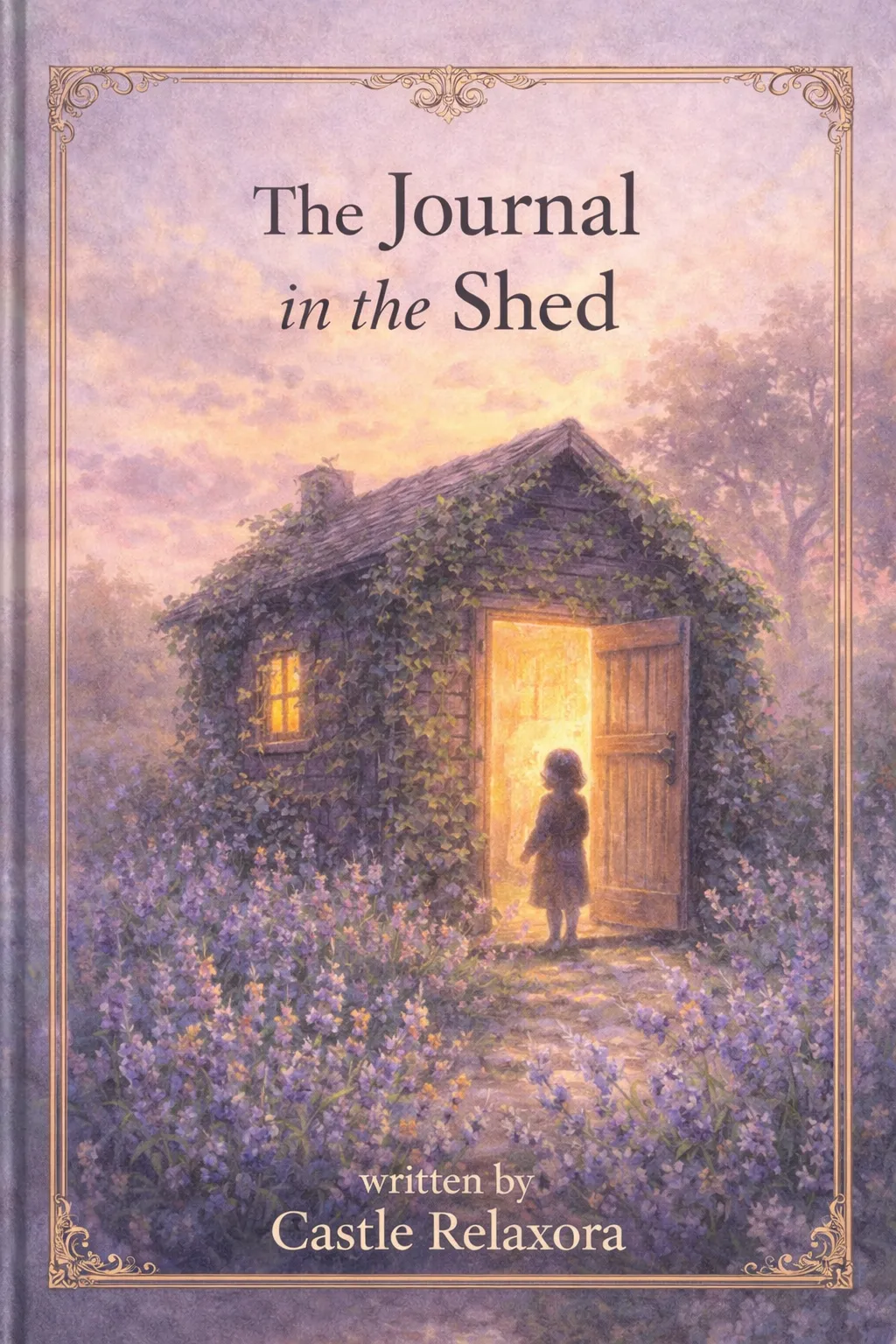
It stood just as it always had. Small. Wooden. Covered in ivy that climbed its sides like time itself had taken root there. But tonight It didn’t feel forgotten. It felt… aware. Rose stopped a few steps away. Her breath slowed. The key grew warmer in her hand. She reached out.
The ivy brushed against her fingers as she cleared a small space around the door. The wood beneath felt smooth, worn, familiar in a way she couldn’t explain. The lock sat quietly. Waiting. Rose lifted the key.
For a brief moment, doubt flickered through her. What if nothing happens? What if it’s just… a shed? But something deeper inside her answered. Then why are you here? She took a breath. And slid the key into the lock. It fit perfectly.
A soft click echoed in the stillness. The sound was small. But it felt like something much larger had shifted. Her hand rested on the door. She hesitated. Not from fear. But from the sense that once she stepped inside, Something would change. And it did.
Chapter 3 — The Room of Quiet Wonders

The door creaked open slowly. Not with the dry groan of old wood, but with a soft, almost welcoming sound. Warm light spilled out. Rose blinked.
For a moment, she thought her eyes were playing tricks on her. Because what lay beyond the door, Was not a shed.
It was a room. A small, quiet, glowing room that seemed to breathe gently, like it was alive in a way she didn’t understand. She stepped inside. The air wrapped around her, not cold, not warm, but comfortable. Like stepping into a place that already knew her.
Shelves lined the walls, filled with objects that didn’t quite belong to the world she knew. Glass jars glowed softly, each one holding tiny flickers of light, fireflies, or something like them, drifting lazily in golden loops.
Books rested in uneven stacks, their covers worn but not dusty. A few pages turned on their own, as if stirred by a breeze that didn’t exist.
From the ceiling hung delicate wind chimes, their tones soft and slow, ringing out in gentle patterns that felt less like sound and more like feeling.
There were carvings too, small wooden shapes of animals and leaves. When she looked at them directly, they seemed still. But from the corner of her eye, she could have sworn they moved.
At the center of the room sat a low table. A cushion. And a journal. The journal’s pages fluttered slightly, though the air was still.
Rose hesitated only a moment before stepping closer. Her footsteps made no sound. She lowered herself onto the cushion. The fabric was soft, worn just enough to feel welcoming as if many others had sat there before her.
But somehow, she felt like the first. The journal rested quietly in front of her. Its cover was simple. No title. No markings. Just presence. Rose reached out.
Her fingers brushed the edge. The pages stilled. She opened it. And there, written in soft, flowing ink, For the dreamer who finds the key. Her breath caught.
The room seemed to grow quieter. Not empty. But attentive. She turned the page. And the story began.
Chapter 4 — The Journal That Wrote in Light

For a few moments, Rose simply stared at the page. The words were written in ink so soft it almost seemed made of smoke, curling gently across the paper in careful lines. She traced them with her eyes again.
For the dreamer who finds the key. No one had ever called her that before. Not out loud, anyway.
People called her bright, or thoughtful, or too quiet when they didn’t know what else to say. Teachers called her capable, usually when handing back papers with notes scrawled at the top. Friends called her absent-minded when she drifted into thought halfway through a conversation. But dreamer, that felt different. It felt as though the journal had not chosen a word for her but recognized one.
Rose turned the page slowly. At first, it was blank. Then, before her eyes, ink began to bloom. Not in a rush, not as if someone invisible were writing quickly from the other side. It came gently, line by line, the way dawn fills a room quietly enough that you almost don’t notice until the darkness is gone.
Rose leaned forward. A story appeared. It told of great sky whales drifting through silver clouds, their songs so deep and low that people on the ground mistook them for thunder. Their backs carried whole gardens of pale flowers that opened only in moonlight. Children in floating boats sailed beside them, tying ribbons to their fins and listening for wishes hidden in their songs.
Rose read every word without lifting her eyes. The room around her seemed to soften as she did. The chimes overhead gave a faint, tender sound. One of the glowing jars on the shelf brightened, then dimmed again, as though breathing in time with the story.
When she reached the end of the page, she turned it quickly, eager for more. Again, the paper was blank. Again, the ink came.
This time it was a tale of foxes in a winter forest, their paws silvered with frost, painting long ribbons of moonlight across sleeping hills. They carried tiny brushes in their mouths and worked in silence while the village below dreamed. By morning, the snow shone like pearl, and no one knew why their hearts felt lighter when they woke.
Rose read until her shoulders relaxed and her thoughts, so often crowded and restless, began to open like hands unclenching. She did not notice how much time had passed until the fireflies in their jars dimmed to a softer gold, like embers settling.
She closed the journal gently. The room hummed around her. It was not silent, not truly. There were soft sounds everywhere if she listened carefully, the faint clink of glass, the rustle of pages in the stacks behind her, the subtle singing of the chimes. But it was the kind of sound that left space around itself. It did not press in. It did not demand.
It let her breathe. That was what surprised her most. Not the stories, though they were beautiful. Not the room, though it felt like stepping into the kind of dream you never wanted to leave. It was the breathing.
At school, every hour seemed filled before it even began. Bells rang. People talked over one another. Phones vibrated. News flashed. Assignments piled up in corners of her mind until even quiet moments felt crowded. Sometimes she lay awake at night with the strange feeling that she had been moving all day without ever truly arriving anywhere.
But here, she felt herself returning to herself. She rested her palms on the table and let out a breath she hadn’t realized she’d been holding.
The room answered with stillness. After that first night, she returned the next evening. And the one after that.
Sometimes she came with a question in her heart, though she would not have known how to phrase it aloud. Why am I so tired? Why does everything feel heavy? Why do I feel far away even when I’m right here? She never asked the journal directly, but somehow the stories it offered always met her where she was.
When she felt lonely, it gave her stories of hidden companions, lantern birds who followed travelers through storms, or tiny watchful creatures who lived in the roots of old trees and kept homes from feeling empty.
When she felt overwhelmed, it offered wide landscapes and unhurried magic, gardens where stars grew slowly from the earth, rivers that carried forgotten worries out to sea, hills where wind turned sadness into songs and scattered them harmlessly into the sky.
And some nights, when her thoughts were too tangled even for stories, she simply sat on the cushion and listened. The room seemed to understand that too.
It never asked for more than she had. It never hurried her. One evening, as rain whispered against the shed roof, Rose opened the journal and found no story waiting.
Only a single sentence, written near the top of the page: You do not always need answers. Sometimes you only need space enough to hear your own heart.
Rose read the line once. Then again. She looked down at her hands, folded quietly in her lap.
Something in her chest tightened, not painfully, but tenderly, like touching a bruise that had begun to heal. She had not realized how long she had been trying to fix every feeling the moment it arrived. To name it. Organize it. Push it away if it was inconvenient.
But the journal seemed to know something she was only just beginning to understand. Not everything needed to be solved. Some things needed to be sat with. Felt. Given room. She closed her eyes. The chimes sounded once, soft and clear. When she opened them again, the page had changed.
A new story was forming, this one about an island that moved slowly across the sea, carrying a single tree with silver leaves. Anyone who rested beneath it for even an hour could hear, for the first time, the truth of what they needed.
Rose smiled without meaning to. Then she read. Night after night, the journal filled and refilled itself, never repeating, never empty for long. But Rose began to notice something else too. The stories were changing. Or maybe she was.
A city floating in clouds appeared one night, but its towers looked strangely like the outlines she used to sketch in her notebooks. A garden of stars reminded her of her grandmother’s flowerbeds, only made luminous and endless. A girl in one story sat beside a glowing lake, knees pulled to her chest, staring at the ripples as if they might explain the world.
Rose read that part twice. Then three times. The room was not only telling stories. It was listening to her. That realization should have frightened her. Instead, it felt like recognition. Like Ellie would later say, though Rose did not know it yet, perhaps the journal did not simply write itself. Perhaps it wrote you.
When at last Rose to leave that night, she touched the cover lightly before closing it. “Thank you,” she whispered. The pages stirred beneath her fingers, just once.
And when she stepped back into the garden, the world beyond the shed was exactly as it had been, cool air, rustling lavender, the dim shape of the house glowing softly through the dark. Nothing had changed. And yet everything had.
She slipped the key into her pocket and walked back through the garden more slowly than before, as though carrying something delicate and unseen. Not a secret she needed to hide. A place she needed to protect. From that night on, the shed was no longer just a hidden room at the edge of the garden. It became a rhythm. A return.
A quiet country inside her life, where she could lay down the noise she carried and remember that there were still gentle things in the world. And perhaps, she thought, gentle things in her too.
Chapter 5 — The Friend Who Understood

Rain had been falling since morning. It was the kind of rain that softened the whole day, turning the garden silver and blurring the windows with patient little streams. Inside the house, her grandmother had lit a lamp in the sitting room though it was only afternoon, and the warm yellow glow made everything feel close and drowsy.
Rose sat by the window with a book open in her lap, though she had read the same page three times without taking in a single word. Her mind kept drifting to the shed.
On rainy days, the thought of it came differently. Not as a mystery, but as a comfort. She imagined the sound of drops on the roof above it, the warm hush of the room within, the journal waiting on the table with its pages closed like folded hands.
A knock sounded at the front door. Rose looked up. Her grandmother rose with a smile. “That will be Ellie.”
Ellie lived two roads away and had been Rose’s friend since they were both small enough to sit side by side in the same garden chair. They had built leaf houses in autumn, whispered secrets beneath blankets on sleepover nights, and once made an entire summer project out of naming every bird that came to the apple tree. Ellie was quicker to laugh than Rose, quicker to speak too, but there were long quiet places in her as well. That was one reason Rose trusted her.
Ellie came in with rain on her coat and brightness in her cheeks. “I nearly got swept away by the puddles,” she announced dramatically, pulling off her shoes at the door. “If I disappear before dinner, please assume I’ve become part of the weather.” Her grandmother chuckled and went to put the kettle on.
Ellie turned to Rose. “You look like you’re somewhere else.”
Rose hesitated. The secret of the shed sat inside her like a small, glowing stone. She had not told anyone about it. Not her grandmother, though she had wondered more than once if she somehow already knew. Not anyone at school. Not even Ellie.
She hadn’t meant to keep it from her friend exactly. It was just that the room felt delicate. Sacred, in a quiet sort of way. Hard to explain without making it sound smaller than it was. But that day, with rain all around them and the afternoon holding its breath, Rose felt the thought rise before she could stop it.
“I want to show you something,” she said. Ellie studied her face for a moment, then smiled. “That sounded mysterious enough that I’m definitely saying yes.” They waited until after tea.
Then, while her grandmother cleared the cups and waved them off with affectionate amusement, they slipped into their coats and ran laughing through the drizzle toward the garden path.
The rain had deepened the colors of everything. Ivy gleamed dark green. Lavender bent under silver droplets. The air smelled of wet earth and leaves.
Ellie followed Rose past the rose bushes and leaning oak, her questions beginning the way they always did when her curiosity took hold.
“Where are we going?”
“Is this about the look on your face the past two weeks?”
“Have you built some kind of hidden fort without me?”
Rose only smiled and shook her head, though her heart had started to beat faster. When they reached the shed, Ellie stopped. “That old place?” she asked.
“I thought it was full of broken tools.”
“So did I.”
Rose reached into her pocket, pulled out the key, and slid it into the lock. The click sounded louder than usual in the rainy hush. Ellie’s mouth fell open. Rose pushed the door inward. Warm light spilled into the dim afternoon. For a moment, neither of them moved.
Then Ellie whispered, “Oh.” That was all. Not disbelief. Not fear. Only wonder. They stepped inside together.
The room welcomed them as it always welcomed Rose, with warmth that seemed to settle not only on skin but somewhere deeper, where tiredness lived. Rain tapped softly on the roof overhead. The jars glowed. The chimes sang one clear note. The journal waited.
Ellie turned in a slow circle, taking everything in. “This is real,” she said at last, almost to herself. Rose watched her closely, some part of her still braced for the moment the spell might break, when Ellie would laugh nervously or start searching for hidden wires or explain it all away into something ordinary.
But Ellie only crossed the room and stood before the shelves as if she had entered a church of small wonders. “Have you been here alone?” she asked. Rose nodded.
“For how long?”
“A few weeks, maybe.”
Ellie looked back at her, not angry, not hurt, only thoughtful. “You must have needed it.” The simplicity of that answer made Rose love her all the more. They sat together on the cushion, knees tucked close, shoulders touching lightly. Rose opened the journal.
At first, the pages were blank. Then, slowly, ink appeared. A story unfolded about a hidden theater in the hollow of an ancient tree, where moths in velvet cloaks performed silent plays for the moon. Each time they lifted their wings, memories fluttered loose into the night and became fireflies.
People who stumbled upon the performances left without quite knowing why their sadness felt easier to carry. Ellie read beside her in stillness. When the story ended, she didn’t speak at once. She touched the corner of the page carefully, as though asking permission.
“It writes itself,” Rose whispered, because she didn’t know what else to say. Ellie’s fingertips lingered at the edge of the glowing paper. Then she shook her head very slightly. “No,” she said. “I think it writes you.” Rose turned to look at her. “What do you mean?”
Ellie drew her hand back and rested it in her lap. “I don’t know exactly. It’s just… these stories don’t feel random.” She glanced around the room. “They feel like they know things. The kind of things you don’t always say.”
Rose thought of the city that looked like her drawings. The girl by the glowing lake. The sentence about needing space enough to hear her own heart. She looked back at the journal. Maybe Ellie was right.
The thought should have felt unsettling. Instead, it brought a strange sense of relief. To be seen so gently, without being pinned down or demanded of. To be known through stories rather than explanations.
They stayed for hours. Sometimes they read. Sometimes one of them would point out some small detail in the room, the way a carved bird seemed to tilt its head when certain words appeared on the page, the way one jar of glowing insects brightened whenever they laughed. Once Ellie found a tiny wooden fox on the shelf whose tail seemed to shimmer silver only when viewed from the corner of the eye.
They spoke too, but softly. The room seemed to shape their voices, smoothing their words until even difficult thoughts came out less sharply. Rose found herself telling Ellie things she hadn’t planned to say. Not grand secrets, but quiet truths. How tired she had been lately without knowing why. How the noise of everything sometimes made her want to disappear for a while. How coming to the shed made her feel as though she could hear her own thoughts again.
Ellie listened without interrupting. “That makes sense,” she said when Rose finished. “I think everyone needs a place like this. Most people just don’t find one.” “And maybe some do,” Rose said, looking at the journal, “but they forget how to come back.”
Ellie was quiet for a moment after that. Then she said,
“Promise me something?”
“What?”
“If I ever forget,” Ellie said,
“you’ll remind me.” Rose smiled.
“Only if you promise the same.”
“Deal.”
By the time they finally left, the rain had softened to a mist. The garden shimmered under the gray evening sky, and everything smelled clean and alive. At the shed door, Ellie paused and looked back inside one more time.
“It doesn’t feel like a hiding place,” she said softly.
“No?”
Rose turned the key in the lock. Ellie shook her head. “It feels like the opposite. Like a place where you stop hiding from yourself.” Rose carried those words with her all evening.
After that day, Ellie became part of the shed’s quiet life. They came together on Saturdays and some evenings after school, sometimes with stories already waiting, sometimes with only silence and warm light. The journal welcomed them both. It never seemed surprised by Ellie’s presence, as if it had expected her all along.
And in those afternoons of rain and dusk and soft pages turning, Rose felt something else growing, not only wonder, not only peace, but the comforting knowledge that magic, however fragile it seemed, did not always have to be held alone.
Chapter 6 — The Years That Gathered

At first, it seemed impossible that anything could change. The shed had entered Rose’s life with such quiet certainty that she began to think of it the way she thought of the moon or the old oak in the garden, something constant, something that would remain itself no matter what else shifted.
For a while, that seemed true. The seasons turned, but the room stayed the same.
In spring, the garden swelled with green life, petals opening one by one as if the whole world were waking slowly from sleep. Rose and Ellie would slip into the shed with damp hems and rosy cheeks, carrying the smell of rain and fresh soil with them. They read stories of secret rivers and willow spirits and silver fish that swam through clouds instead of water.
In summer, sunlight lingered long into evening. The path to the shed warmed under their feet, and the lavender outside buzzed with bees so content it sounded almost like singing. The journal gave them bright stories then, of sunlit islands, glass-winged insects, and children who climbed ladders woven from sunlight to gather fruit from the edges of dawn.
In autumn, leaves rustled down around the shed roof and gathered in golden drifts along the path. The air sharpened. The light softened. The journal’s stories deepened too, full of lantern processions, sleeping orchards, and old maps that only appeared when someone was brave enough to let go of what they thought they already knew.
And in winter, when frost embroidered the garden and the world outside felt held in quiet hands, the room became even warmer by contrast. Rose and Ellie would sit close together on the cushion, wrapped in sweaters, while stories unfolded of snow forests, candlelit villages, and creatures with bright eyes leaving tiny silver footprints over moon-washed fields.
The shed did not seem touched by time. But Rose and Ellie were. Slowly, in ways almost too small to notice at first, their lives began to fill.
Homework multiplied. Tests appeared and then more tests after them. Teachers began talking not only about grades, but futures, and futures arrived in conversation carrying a heavy sort of importance. What would you choose? Where would you go? Who would you become? Questions that were meant to feel exciting often settled on Rose like weights she was not ready to hold.
Ellie’s life grew busier too. She joined clubs, stayed late for rehearsals, started carrying a planner full of color-coded notes and folded papers tucked between the pages.
At first, none of this seemed to matter. They still found their way to the shed, even if not as often. Then once a week became every other week. Then less.
Rose noticed it one afternoon in late autumn. She had gone to the shed alone because Ellie had practice, and as she sat on the cushion with the journal open in her lap, the room felt no less warm than before, but larger somehow.
Not emptier. Just full of Ellie’s absence. The story that appeared that day was about two birds who built their nests on opposite cliffs and learned to trust the wind to carry their songs between them. Rose read it twice. When Ellie came again the following Saturday, Rose almost told her that. Instead they laughed over hot tea and read a story about moonlit staircases that only appeared in puddles.
Time moved on. There were school dances neither of them were sure they wanted to attend until everyone else insisted they should. Group projects. Family obligations. The strange, shifting social weather of growing older, when friendships could still be true and close but become threaded with missed calls, changed plans, and the quiet ache of being pulled in different directions.
None of it happened dramatically. That was what made it harder to name. There was no fight. No betrayal. No slammed door or cruel word. Only accumulation. Only life.
Rose still thought of the shed often, even on days she didn’t go. She would catch the scent of lavender on her sweater and feel her thoughts turn instinctively toward the hidden room. Sometimes, when everything felt especially loud, she promised herself she would go that evening, only to arrive home tired, with assignments waiting and messages to answer and the strange inertia that comes from wanting peace so badly you no longer have the strength to seek it.
On those nights, the guilt stung. As though she were abandoning something kind. But when she did return, the room never made her feel late. It was always the same when she opened the door: warm, lit from within, patient.
The journal never accused. The pages simply opened. The stories continued. One evening, after several weeks away, Rose found only a single line waiting for her. Even forgotten paths remember the shape of your feet. She sat very still after reading that. Then she closed her eyes and let herself breathe.
Winter passed. Spring came again. And then, one bright afternoon with a restless wind moving through the trees, Ellie arrived at Rose’s house with a face that looked too carefully arranged. Rose knew at once that something had happened.
They walked out into the garden without speaking much, their feet taking the familiar path toward the shed as if by instinct. But when they reached the door, Ellie stopped.
“I can’t stay long,” she said. Rose turned to her. Ellie’s hands were wrapped tightly together.
“My dad got a new job.” Rose waited.
“It’s in another city.”
The words landed softly, but the feeling that followed was not soft at all. It was hollow and immediate, like stepping where you thought there would be ground and finding only air.
“Oh,” Rose said.
She heard the smallness of her own voice and hated it, because the moment deserved something larger. But no larger words came.
“We’re moving at the end of summer,” Ellie said.
Rose looked at the shed door, then back at her friend. Around them, the lavender stirred in the breeze. Somewhere farther off, a bird called once and then was quiet.
“That’s… soon.”
Ellie nodded.
For a while they stood there without saying anything. Then Rose unlocked the shed.
Inside, the room glowed as it always had, indifferent only in the gentlest sense, the way the sea remains itself when someone cries beside it. The journal waited on the table. The cushion held them both as they sat down shoulder to shoulder.
When Rose opened the page, the ink appeared more slowly than usual. It formed a story of a tree growing at the border between two kingdoms. Half its branches bent toward one land, half toward the other, but the roots below were shared. People on both sides came to sit beneath it and believed it belonged to them alone, until one winter they learned that the tree survived not because it chose one side or the other, but because it held both.
Ellie read with her hand resting lightly against Rose’s arm. Neither of them spoke until the story ended.
Then Ellie said, “I don’t want things to change.”
Rose swallowed. “I know.”
“I’m scared they will anyway.”
Rose looked down at the page, where the last line of the story was still dark with fresh ink.
“Maybe some things change shape,” she said slowly, “without disappearing.”
Ellie leaned her head gently against Rose’s shoulder.
“Promise me you’ll keep coming here.”
Rose smiled sadly. “You too.”
Ellie let out a breath that was almost a laugh. “That might be hard from another city.”
“Then promise you won’t forget it.”
Ellie was quiet for a moment. “I won’t.”
Summer came and moved too quickly.
There were boxes at Ellie’s house. Farewell dinners. The awkward brightness people wear when they don’t want sadness to take over an important moment. Rose and Ellie still found time for the shed a few more times, holding on to those afternoons as if lengthening them might delay what was coming.
But the day arrived all the same.
After Ellie left, the garden felt altered. Not broken. Just missing one familiar note, the way a song feels changed when one instrument falls silent.
Rose still visited the shed.
But less. Not because she loved it less. In some ways she loved it more, now that it held so much memory. Perhaps that was part of what made it harder. Every warm afternoon there carried an echo. Every story seemed to touch not only who she was in that moment, but who she had been there before.
School grew more demanding. Then came years that felt built of lists and calendars and obligations. New people entered her life. Some stayed for a while. Some did not. Rose changed in the uneven, invisible ways all people do as they move from one age into another. She became more capable, more responsible, more certain in some things and more quietly uncertain in others.
And the shed, The shed waited. Through spring rains and summer heat, through leaves thickening and falling, through winters that silvered the garden and springs that greened it again, it remained behind the ivy and the leaning oak, not calling loudly, never pleading, only present.
A constant she did not always choose, but never truly lost. Sometimes months passed. Then one day a scent, a sound, a tiredness too deep for ordinary rest would turn her feet toward the garden path again.
And each time, the lock would yield. The room would glow. The journal would open. As if saying, in the only language it knew: You are not starting over. You are returning.
Chapter 7 — The Return to Quiet

Years passed before Rose returned in the way she once had. Not for a hurried visit between one obligation and the next. Not for an hour stolen from a busy afternoon, though she had done that more than once. This time, she returned because something in her had reached a kind of still breaking point—not dramatic enough for anyone else to notice, but unmistakable to her.
She was older now. Old enough that people expected steadiness from her. Old enough to carry calendars full of appointments and lists full of tasks and the invisible, exhausting work of being reliable. She had grown skilled at moving through crowded days. Answering messages. Meeting deadlines. Remembering birthdays. Planning ahead. Keeping things in order.
From the outside, her life looked reasonable. Perhaps even good. But inside, she often felt as though she lived too close to the surface of everything.
She moved from one necessity to the next without quite sinking fully into any moment. There were days she missed herself in ways she couldn’t explain. Not because she had become someone false, but because she had become someone constantly occupied. Then one autumn afternoon, she found herself back at her grandmother’s house.
The air was crisp enough to sharpen every scent. The garden was quieter than it had been in summer, but no less beautiful for it. Lavender still moved softly in the wind, though the blooms were thinner now. Leaves drifted from the old oak and gathered along the path in amber curls.
Rose stood for a long time at the kitchen window before going outside. She could see the garden clearly from there, just as she had as a girl, the path beyond the roses, the stretch of ivy, the suggestion of the shed half-hidden in green and shadow.
A memory moved through her so strongly that she had to set down her teacup. Warm pages. Rain on the roof. Ellie saying, I think it writes you. The single line: Even forgotten paths remember the shape of your feet.
Without allowing herself time to think too much, Rose pulled on her coat and stepped outside. The garden received her quietly. She walked slowly, more from feeling than caution, letting the familiar route rise up beneath her. The path was narrower than she remembered, or perhaps she was larger now and carried more with her. Ivy had thickened along the fence. Moss had climbed farther over the stones. The shed stood at the edge of it all, wrapped in age and green life, waiting in the patient way only certain places know how to wait.
For a moment, Rose simply stood before it. She noticed the weathered grain of the wood. The tendrils of ivy crossing the door. The faint trembling in her own hands.
Then she reached into her pocket. The key had lived in the back of a drawer for years, tucked inside a small tin box with other things she could never quite throw away, a ribbon, an old photograph, a pressed leaf from a long-ago autumn. Yet when she held it now, it still felt familiar against her palm.
Not as warm as the day she found it. But warm enough. She brushed the ivy away carefully. Inserted the key. Turned. The lock clicked with the same soft certainty it always had. Rose let out a breath. Then she opened the door. Warmth unfolded toward her. No rush of wind. No blinding light. No grand display announcing that she had done the right thing by returning. Only warmth.
And the room, exactly as it had always been. The shelves still lined the walls with their jars of living gold and their feather-light books. The chimes hung overhead, stirring with music that seemed to exist halfway between sound and memory. The little carvings rested in their places, still and not still. The cushion waited by the low table.
And there, at the center, lay the journal. Rose stepped inside and closed the door behind her. At once the outside world softened to a distant hush. She removed her coat, folded it neatly over the back of the chair that had always somehow been there though she never remembered noticing it before, and lowered herself onto the cushion.
For a while, she did nothing. She simply sat. Her eyes moved slowly over everything she had once known so intimately. The room did not look smaller than her memory, as old places sometimes do. If anything, it felt deeper. More layered. As though every visit she had ever made remained suspended there like breath on cold air, invisible but present.
She reached toward the journal. Paused. Then opened it. The first page was blank. Rose blinked. She turned the page. Blank. Another. Blank again.
She sat back slightly, surprised, not disappointed exactly, but caught off guard. The journal had always been waiting with words. A story. A sentence. Some gentle opening offered before she even knew what she needed. Now there was only emptiness. But as she looked more carefully, the blankness did not feel cold.
It did not feel like absence. It felt like invitation. Rose’s expression softened. Of course. The room had given her stories when she needed stories.
Space when she needed space. Silence when she needed silence. And now, perhaps it was asking something back from her. Or not asking, exactly. Trusting.
A pen lay beside the journal, simple and dark, as if it had always belonged there. Rose picked it up. It fit her hand easily. She looked down at the waiting page and suddenly felt shy, the way people do when they are about to tell the truth without knowing what shape it will take. She had spent years writing practical things, notes, reminders, answers, carefully measured messages. But this was different.
This was not writing to finish a task. This was writing to arrive. Outside, wind moved through the lavender and tapped one loose branch softly against the shed wall. Inside, the chimes gave a quiet, shimmering note. Rose touched the pen to the page. For a moment nothing came. Then, slowly, she wrote:
I had forgotten how to be still.
The words sat there, small and honest. She read them once. And something in her chest loosened. She wrote another line. Then another. Not a polished story, not at first. More like pieces of breath turning into sentences. She wrote about the garden. About noise. About the tiredness she carried without speaking of it. About Ellie’s laughter in rainy afternoons. About how strange it was to miss a version of yourself that had once felt so ordinary. She wrote about the comfort of being known by a place that asked for nothing except that she arrive.
When she paused, the room seemed to settle around her more deeply, pleased in its quiet way. Rose looked back at what she had written. The page glowed very faintly at the edges. She smiled. Then she kept going.
The writing changed as it moved. What began as memory slowly unfolded into story, not because she forced it to, but because the room had always spoken that language. The garden became larger, gentler, touched with a little more wonder. The shed became a threshold. The girl in the story was not exactly Rose and not not-Rose either. She was someone carrying too much noise who found, by accident or by grace, a door into stillness.
Rose did not rush. There was no reason to. The old urgency that ruled so much of the rest of her life could not survive in this room. Here, each sentence seemed to ask only to be true. Each pause was part of the work. Each breath belonged.
By the time she finally set the pen down, the light in the jars had deepened from gold to amber. Outside, evening was gathering. Rose placed her palm lightly on the page. Warm. The same quiet warmth she had felt years ago in the key. A laugh escaped her then, small, soft, surprised at itself. “So that’s what you were waiting for,” she whispered. The chimes answered in a low, lovely murmur. She turned back to the first page of the journal, the one that had once held the words, for the dreamer who finds the key.
Now, written beneath it in the same flowing hand she remembered, a new line had appeared. And for the dreamer who returns. Rose stared at the words until her eyes blurred. Not from sorrow. From recognition.
From the simple tenderness of being welcomed twice. She closed the journal carefully. Then she sat a while longer in the fading light, not thinking ahead, not measuring time, not asking herself how long this calm would last once she stepped back into the world. That question no longer felt necessary.
The world outside would still be noisy. There would still be deadlines, phones, headlines, errands, unfinished conversations, and days that crowded in too closely. But now she remembered something she had once known with her whole heart: Peace did not have to mean escape.
Sometimes it was return. Sometimes it was a hidden room, yes, but sometimes it was the part of yourself that room helped you find and carry back out. When Rose finally stood, she took one last look around the shed. Nothing in it asked her to stay forever. That was not its magic.
Its magic was gentler than that. It reminded her that she could always come back. To the room. To the page. To herself. She put on her coat, slipped the key into her pocket, and opened the door. Cool evening air met her face.
The garden rustled softly under the darkening sky. Lavender shifted in the wind. The old oak stood watch. Somewhere above, the first star had begun to show.
Rose stepped onto the path and closed the door behind her. Inside, the chimes sang once. Outside, she smiled and began to walk toward the house, not hurriedly, not heavily, but with the quiet steadiness of someone carrying a small, lit thing within her.
And in the shed, on the table, the journal rested open to its newest pages. Waiting. Not for magic to begin. But for it to continue.
A Few Gentle Truths…
──────── ✧ ────────
Create space for your imagination, even when life is loud.
Not every feeling needs to be solved immediately. Some need gentleness and room.
The places that truly heal us never demand perfection; they simply welcome our return.
Friendship can hold silence just as beautifully as conversation.
Growing older does not mean losing wonder—it means learning how to find your way back to it.
Coming back to what you love can help you remember who you are.
──────── ✧ ────────
Continue your quiet journey with Castle Relaxora
Unlock more peaceful stories.