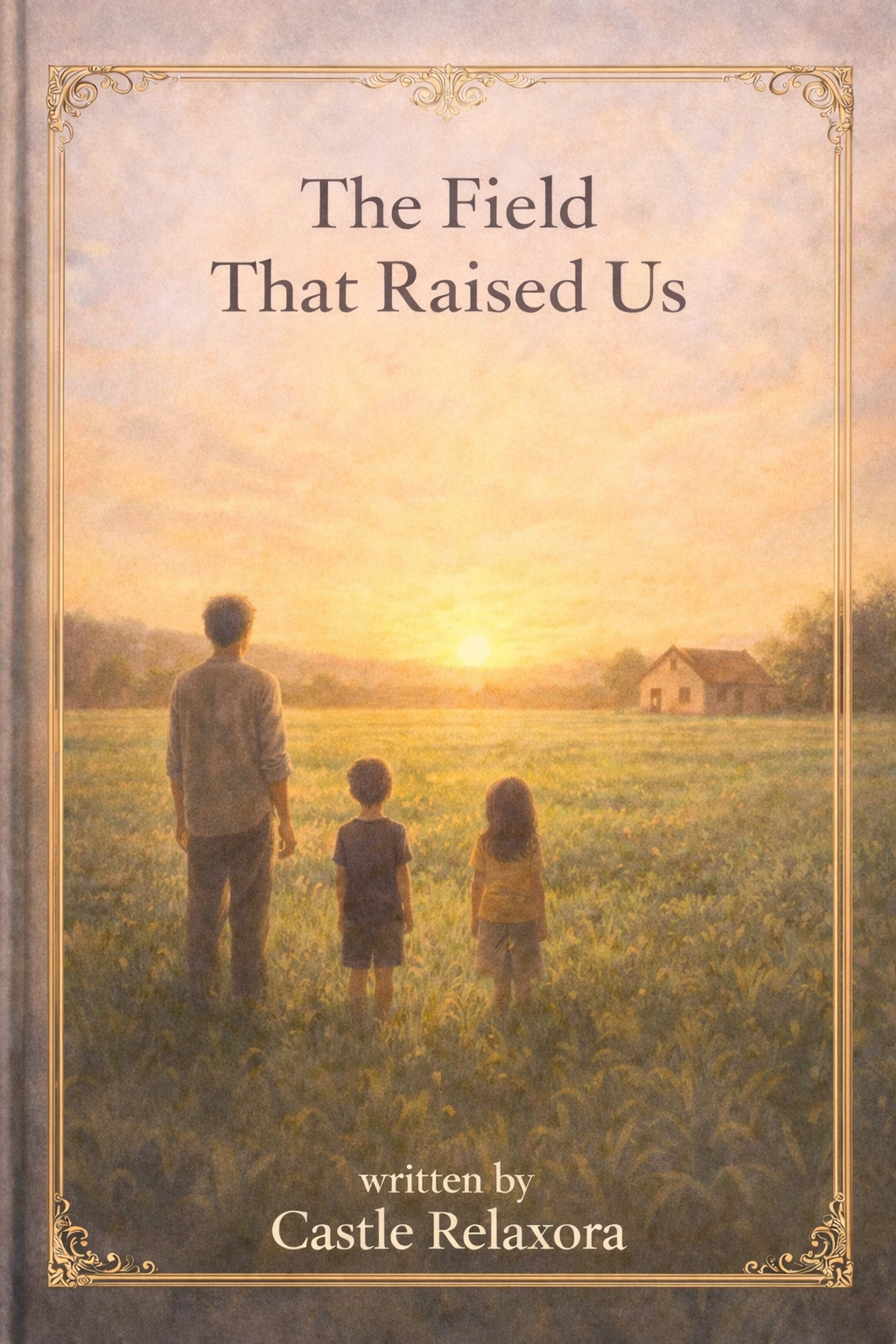
Chapter 1 — The House Near the Fields

The house stood at the edge of the fields, where the land stretched wide and open as far as the eye could see.
It was not the kind of house people noticed when they passed by. There was no paint freshly layered on its walls, no decorative fence, no garden arranged with intention. The roof had weathered many seasons, its edges slightly uneven. The wooden door carried faint scratches from years of use, opening with a familiar creak that never quite went away.
But it stood firmly. And it held everything that mattered. In the early years, the house had been full. Not with noise, but with life. The kind of life that lived in small things.
A woman moving quietly in the kitchen, her voice rising into soft songs that didn’t need words. The smell of rice cooking in the evening. The sound of children laughing as they chased each other across the small open space in front of the house.
Their father returning at dusk, his footsteps slow but steady, carrying the weight of the day without complaint. Those were the days Arun would run to the door before it even opened. “Dad is back!” he would shout, even when no one had asked. Meera would follow, smaller, quieter, but just as eager.
Their mother would stand in the doorway, wiping her hands on the edge of her saree, smiling in a way that made everything feel settled. Those moments did not last long. But they lasted enough to be remembered.
The change came slowly. At first, it was only a tiredness. Their mother rested more than usual. She sat down while cooking. She paused between tasks that once moved easily from one to another. Then came the silence. The songs became softer. Then fewer.
The doctor came one afternoon. Then again the next week. Then again. Arun did not understand. He watched from the doorway as adults spoke in low voices. He noticed the way his father stood still while listening, his expression unchanged, but something in him had shifted.
Meera stayed closer to her mother. She sat beside her. Held her hand. Did not ask questions she didn’t yet have the words for. Days became different. The house felt smaller. Not in size. But in sound.
One evening, as the sky faded into a pale gray, their mother called them close. “Come here,” she said gently. Arun moved first. Meera followed, holding onto the edge of his shirt.
Their father stood nearby. Not speaking. She placed her hand on Arun’s head. Then on Meera’s. “Take care of each other,” she said. Her voice was calm. Too calm. Arun nodded, not fully understanding. Meera pressed closer. Their father looked away briefly. Not for long. Just enough.
That night, the house changed.
There were no loud sounds. No sudden shift. Just stillness. The kind that settles slowly, like dust, until it becomes part of everything. In the days that followed, their father did not speak about it. He did not explain loss. He did not try to replace what could not be replaced. Instead, He continued.
The next morning, he woke before sunrise. The sound of his footsteps returned. The creak of the door. The quiet preparation before stepping into the fields. Arun noticed. He sat up earlier. Watched. The sky was still dark when his father stepped outside. The air carried a softness that belonged only to early morning, when the world had not yet begun to move.
From the doorway, Arun saw him walk toward the fields. Not fast. Not slow. Steady. That word would stay with him. Meera woke later. She noticed something different too. The house felt quieter. But not empty.
Their father returned later that day, just as before. His clothes carried the scent of soil and sun. His hands were rougher. He washed. Sat down. And ate with them. Dinner was simple. Rice. A little curry. Nothing more. But it was shared. And in that sharing, Something held.
Evenings became quieter. There were no songs. But there were stories. Not every day. Not long ones. Sometimes just a few words. “Finish what you start,” their father said once, while repairing a broken tool. Arun watched. Meera listened.
Another evening, “Things grow slowly,” he said, looking out toward the fields. They did not understand fully. But they remembered. Time moved. The house did not return to what it had been. But it did not remain broken either. It became something else. Quieter. Stronger. A place where love did not need to be spoken loudly to be known. And outside, The fields continued. Unchanged. Always growing.
Always waiting.
Just like the life within the house.
Chapter 2 — The Hands That Never Rested

The fields did not wait for grief. They did not pause. They did not soften their demands. The sun still rose before the village stirred. The soil still needed turning. The water still needed guiding. And their father, Rose with it.
Each morning began before light. Not suddenly. Not with urgency. But with quiet certainty. The house would still be wrapped in darkness when he woke. The air inside held the last traces of night, cool and still. He moved carefully, not to wake the children, his steps familiar enough to avoid sound, his hands knowing exactly where everything was without needing to search.
He would step outside before the sky had fully opened. That was Arun’s first memory of strength. Not loud. Not dramatic. But consistent.
At first, Arun only watched. From the doorway. From the small space where the inside met the outside. His father would walk across the path toward the fields, his silhouette steady against the faint light beginning to rise behind him. There was something in that walk. No hesitation. No resistance. Just movement.
One morning, Arun followed. He did not say anything. He did not ask permission. He simply walked behind. The ground was cool beneath his feet. The grass still carried dew, brushing lightly against his ankles as he moved. The air smelled different out there, fresh, open, carrying something alive that the house could not hold.
His father noticed. Of course he did. But he did not turn immediately. He continued walking. Only when they reached the edge of the field did he pause.
“You woke early,” he said. Arun nodded. A pause. “Then stay,” his father said. That was all. No instructions. No expectations. Just, Presence.
From that day, Arun began to go with him more often. At first, he only stood nearby. Watching. The way his father held the tools. The way he moved through the rows. The way he paused, not because he was tired, but because he was paying attention.
“Look,” his father said once, pointing to a small patch of soil. Arun leaned closer. “What do you see?” “Nothing,” Arun replied. His father shook his head gently. “Look again.” Arun stared longer this time. And slowly, He noticed. A small green shoot. Barely visible.
“It’s growing,” he said. His father nodded. “Everything is,” he replied. “You just have to give it time.” Arun remembered that. Not because it was explained. But because it was shown. Meera stayed closer to the house. At first. She helped in ways that were quieter. Filling water. Preparing small things. Keeping the space in order.
But she noticed just as much. She noticed the way her father never left anything unfinished. The way he repaired tools instead of replacing them. The way he spoke less but meant more. In the evenings, she would sit beside him. Not asking questions. Just listening.
“Why don’t you rest?” she asked once. Her father looked at her. “I do,” he said. She tilted her head. “When?” He looked out toward the fields. “When the work is done.” She did not argue. But she watched more closely after that.
She noticed something then. His rest was not in stopping. It was in continuing. Dinner remained simple. But it was never rushed. They sat together every night. The same place. The same routine.
Some evenings were quiet. Others held small conversations. “What did you learn today?” he would ask. Arun would speak about the fields. Meera would speak about what she noticed. Their father listened. Always. Not correcting. Not interrupting. Just listening.
Time moved. Seasons changed. The fields shifted from green to gold to brown and back again. The children grew. Arun’s hands became stronger. Meera’s understanding deeper. But their father remained the same. Steady. There were days when the work was harder. Days when the rain did not come. Days when the crops did not grow as expected. But he did not change.
He did not speak of difficulty as something unusual. He simply continued. And in that continuation, the children learned something greater than words. They learned that strength is not loud. It is repeated. Every day. Without announcement. Without expectation.
One evening, as the sun lowered slowly across the fields, Arun sat beside his father, both of them looking out at the land they had worked all day. “Does it ever get easier?” Arun asked. His father thought for a moment. Then said “No.” Arun looked at him. “But you do,” he added. Arun did not fully understand. Not yet. But he would.
In time. The house held them. The fields shaped them. And their father taught them. Not through lessons. But through living.
This story continues with Premium Access.
Carry This With You…
──────── ✧ ────────
Some lives are built loudly.
Some are built quickly.
But the strongest lives
Are built quietly.
In early mornings.
In steady work.
In love that does not ask to be seen.
And when they grow
They carry their roots with them.
──────── ✧ ────────
Continue your quiet journey with Castle Relaxora
Unlock more peaceful stories.